
This task is a literature task revolving around a specific literary work. For this reason it has a different setup than ordinary tasks.
Welcome to Channelling Chaucer
Start here
Read this page and watch the videos. Then go to Step 1: Start here (at the bottom of this page): there you find your 5-week plan, the tale menu, what gets signed off – and the check about this page.
The big question of our literature line: Who has the right to rule: blood, God, law, or the people? Keep it in mind while you read Chaucer.
Play the video* below and listen…
An Introduction…
Geoffrey Chaucer Shakes Things up
Hey there! Imagine this: it is the late 1300s, and a man called Geoffrey Chaucer decides to shake up the English literary world. Picture the court of King Richard II: for about three hundred years, since the Norman Conquest of 1066, the language of power and prestige in England has been Norman French (and Latin, for the Church and for learning) – the languages of the elite.
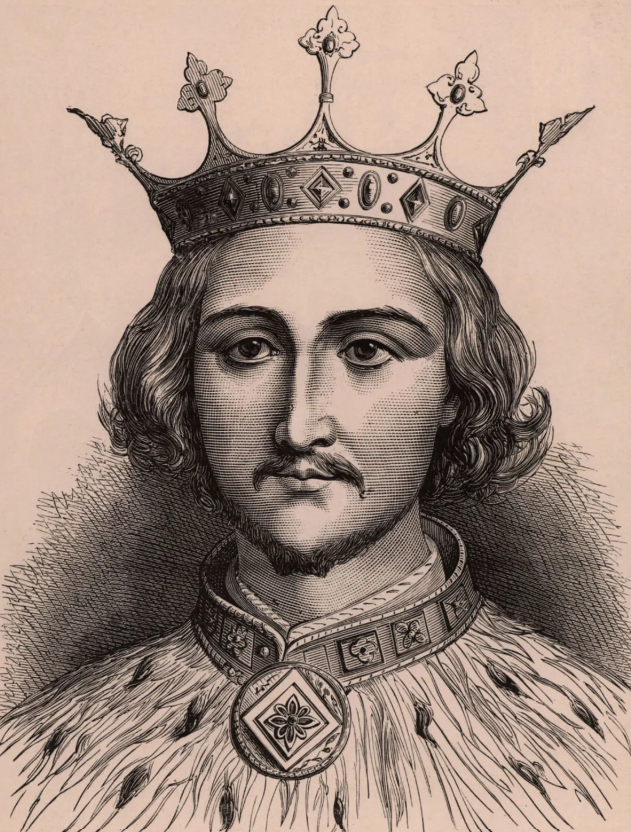
But Chaucer? He goes bold and writes his epic, “The Canterbury Tales,” in English – yep, the language ordinary folks like us speak.
Well, sort of. Remember year 4 where you believed Shakespeare was Old English? Well, it wasn’t. It was Early Modern English, and this? Well, this falls between Beowulf’s Old English that you will study next year and Shakespeare’s Early Modern English. It is Later Middle English (and definitely super hard for us ‘ordinary folks’ to understand!) 😉
Wat is het verschil tussen ‘a hearthy welcome’ (een hartelijk welkom) en ‘a cordial reception’ (een cordiale receptie)? In een korte, bewogen geschiedenis van het Engels verklaart Kate Gardoqui waarom semantisch gelijke zinnen zulke verschillende beelden kunnen oproepen. Klik hier als de video niet laadt.
The What-Tales? The Canterbury Tales
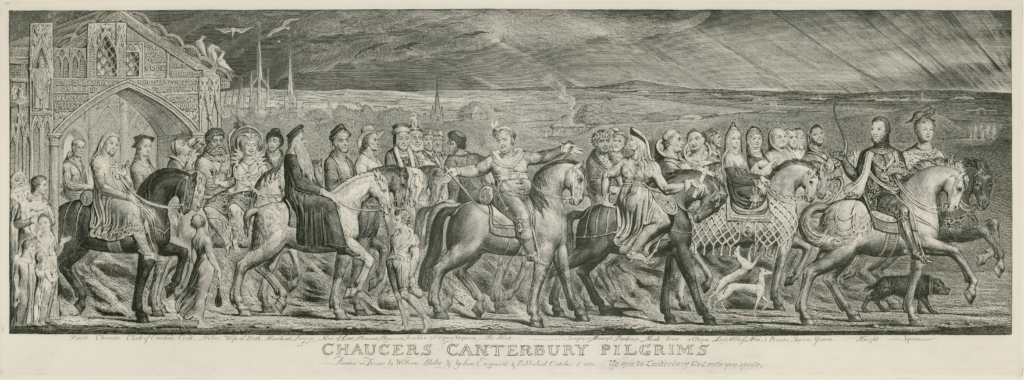
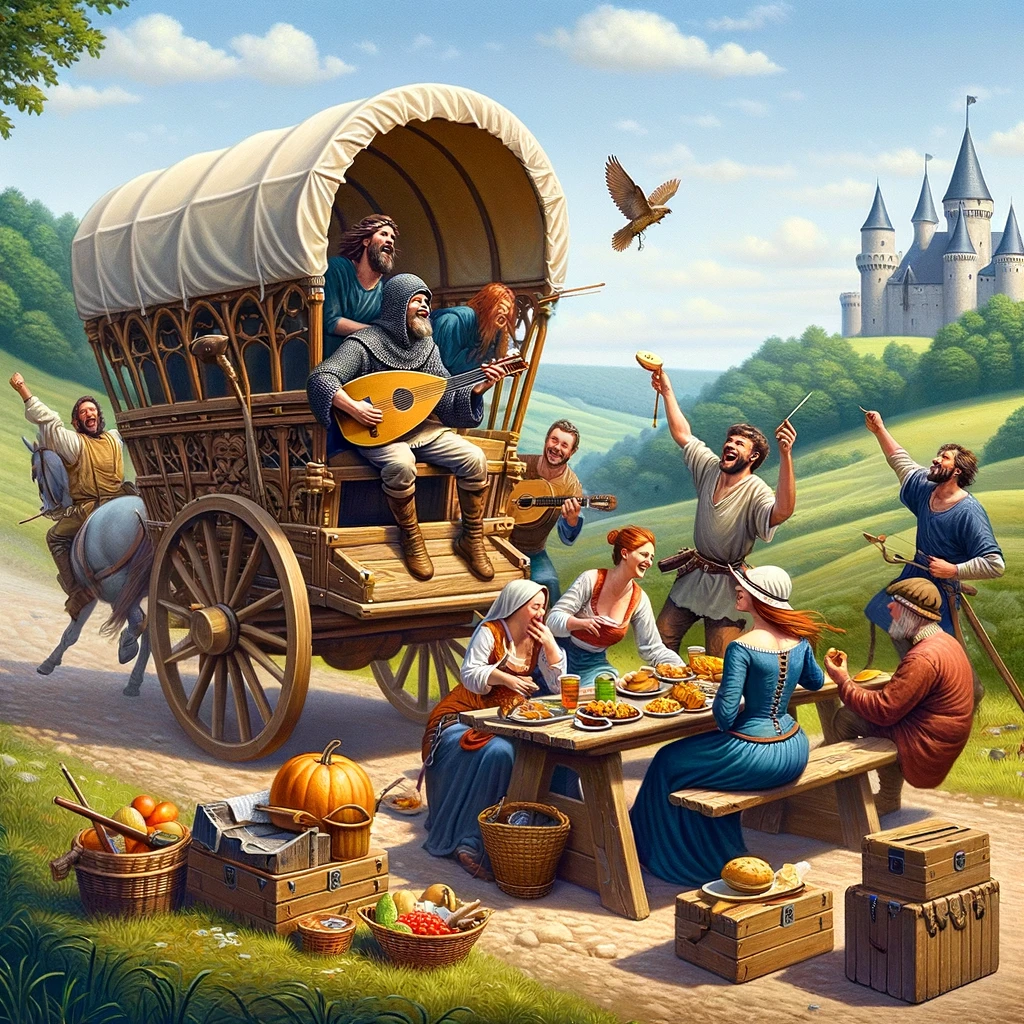
So, what’s the big deal about “The Canterbury Tales”? It’s a whopping 17,000-line poem that’s kind of like a medieval road trip story. However, instead of listening to your favourite songs blasting through the speakers with your friends, you listen to each other’s stories. Every tale part of the Canterbury Tales is one of these stories. So, it is a collection of stories within a story.
Who are Supposed to Tell these Stories?
Chaucer and 29 other pilgrims – a wild mix from most walks of life of that time (look at the pyramid below: most of them come from the middle layers, a few from the bottom) – are heading to the shrine of St Thomas Becket in Canterbury Cathedral. The Host of the inn where they meet, Harry Bailly, joins them.
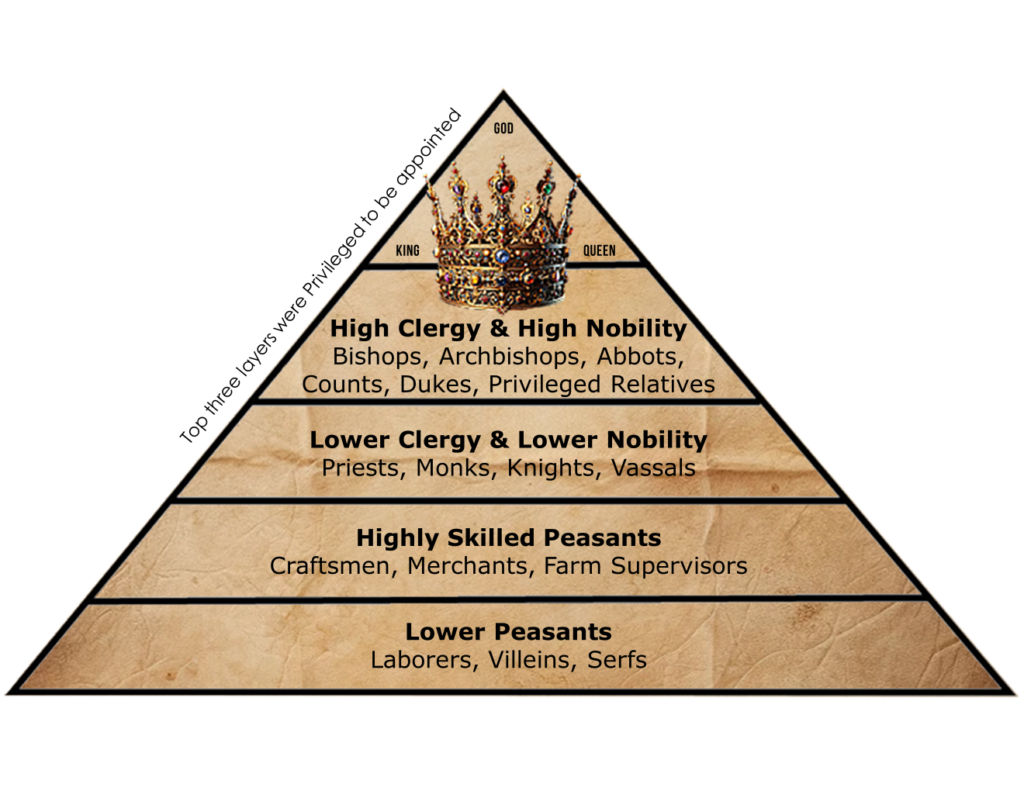
Alright, let’s throw it back to Year 1 history class and talk about the feudal system – medieval style. Picture this: William of Normandy has just conquered England and he’s like, “Okay, how do I keep this massive place under control?” His genius plan? Feudalism.
So, William starts handing out huge chunks of land to his squad – the guys who helped him win. This move basically kicks off the whole feudal system. Imagine a society that’s less like a community and more like a pyramid.
At the top, you’ve got the King or Queen, chilling just below God – because back then, people believed God was the one giving them the thumbs up to rule. Right under them are the nobles, these are the rich and powerful folks who got those big land gifts from the king.
Then you have the knights. Think of them as the medieval bodyguards or soldiers, serving the nobles and king.
But here’s the catch: most people were peasants. We’re talking over 90% of the society. These folks were at the bottom of the pyramid, doing all the hard work, like farming, with barely any rewards.
So, the feudal system was basically a way to organize society, but it also created this massive gap between the uber-rich and the super-poor. It was like the medieval version of ‘the rich get richer, and the poor get… well, you know.’ And that’s the throwback to how society was structured back in the days of knights, castles, and conquests.
What did they do?
They’re all telling tales, and man, the variety is something else – These stories are like a snapshot of 14th-century England. We get to know a lot about the time by reading the stories.
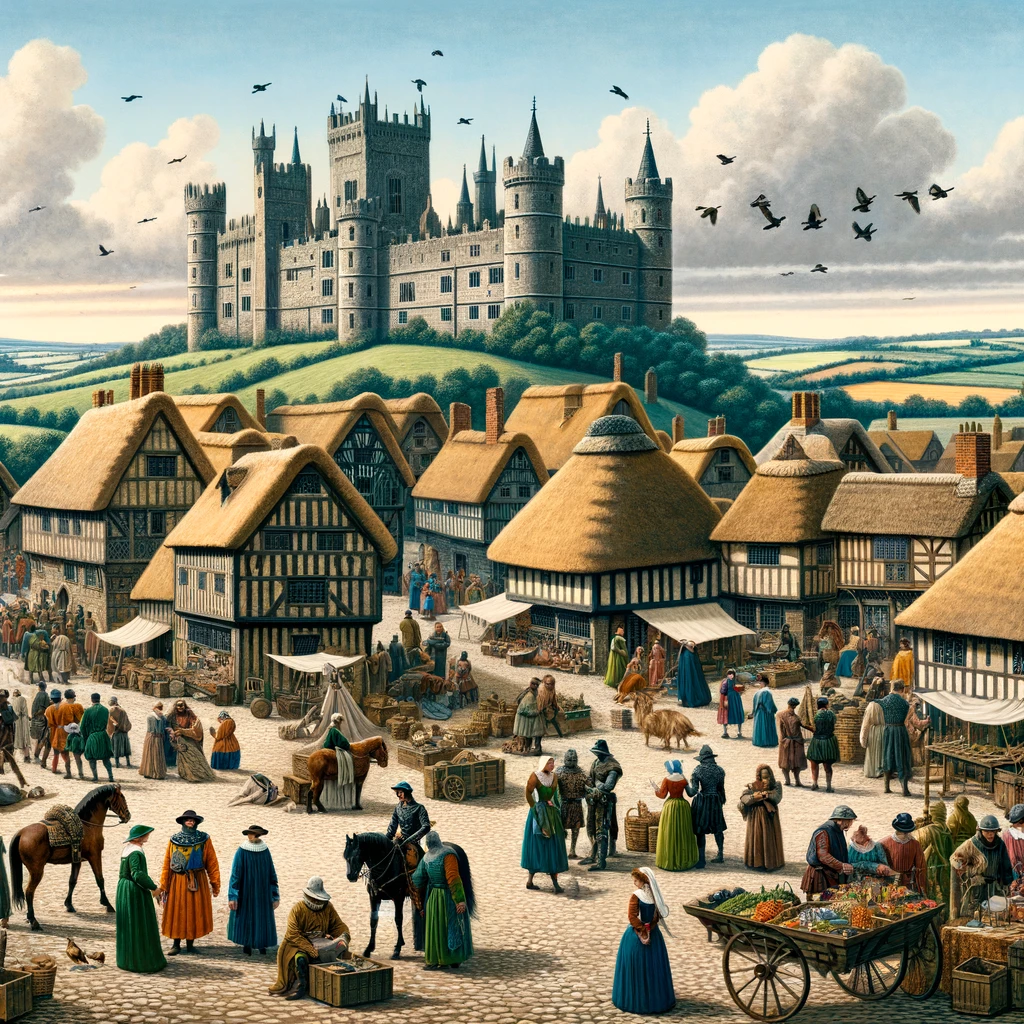
Wasn’t it a Bit Much?
Chaucer was super ambitious. He wanted to cram over 100 stories into this thing, with each character telling a couple (2) on the way to Canterbury and a couple more (2) on the way back. But here’s the twist – he didn’t finish it. He left us with only 24 stories before he passed away. And get this – before the printing press was even a thing, these tales were all handwritten and shared around.
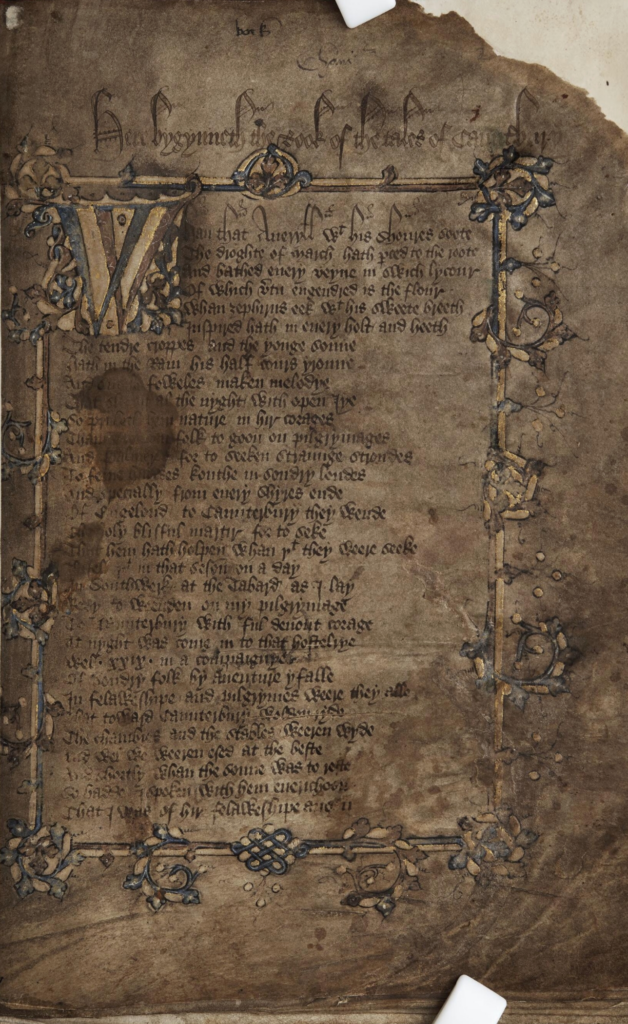
That’s like going viral in the olden days! More than 80 handwritten copies of this manuscript have survived – a sign of how popular the tales were. The first printed edition appeared in 1476, made by William Caxton. So, when you dive into “The Canterbury Tales,” you’re not just reading a story, you’re time-traveling into a world where Chaucer changed the game by choosing to write for the people, in the people’s language. Pretty cool, right?
*What would the Tabard Inn have sounded like?
The Framed Story
Alright, let’s dive into Geoffrey Chaucer’s world, specifically his famous “The Canterbury Tales.” Think of it as the ultimate collection of stories from way back in the late 1300s. However, his stories weren’t separate stories, they were a bunch of tales wrapped into one big story.
This type of story in which stories exist within a story is called a framed story. Another example of a framed story is One Thousand and One Nights; One Thousand and One Nights is a collection of Middle Eastern folktales compiled in the Arabic language during the Islamic Golden Age. It is often known in English as the Arabian Nights. Most of you will know the story of Ali Baba and the Forty Thieves, or the tale of Aladdin and the Magic Lamp. The words ‘Open, Sesame!’ are famous even to people who have never read the story of the crafty thief and his adventures. If you are curious about the Arabian Nights, click the bar below:
- King Shahryar’s Betrayal and Vow: King Shahryar discovers his wife’s infidelity and, in his bitterness, vows to marry a new virgin each day and execute her the next morning to prevent any further betrayal.
- Shahrazad’s Strategy: Shahrazad, the daughter of the king’s vizier, offers herself as the next bride. She has a plan to avoid execution and bring an end to the king’s cruel practice.
- Tales Each Night: On their wedding night, Shahrazad begins to tell the king a story, but she doesn’t finish it. Intrigued by the tale, King Shahryar postpones her execution to hear the story’s end.
- A Thousand and One Nights: This process continues for 1,001 nights. Each night, Shahrazad tells a story, leaving it incomplete and promising to finish it the next night. The stories she tells are the various tales that make up “The Arabian Nights.”
- Change in the King: Over time, through her stories, Shahrazad teaches King Shahryar about justice, kindness, and the folly of his ways. Her stories often contain morals and lessons, and they captivate the king.
- The Conclusion: After 1,001 nights, Shahrazad reveals that she has no more tales to tell. By this time, King Shahryar has fallen in love with her and has also repented for his cruelty. He revokes his vow and makes her his queen.
The Frame
The frame around The Canterbury Tales is the following: It all starts in an inn (the Tabard Inn), hence the video with the Inn music, where Chaucer and 29 other pilgrims are chilling before they head out on a pilgrimage to Canterbury, England. They are challenged by the Inn’s host: Harry Bailly.
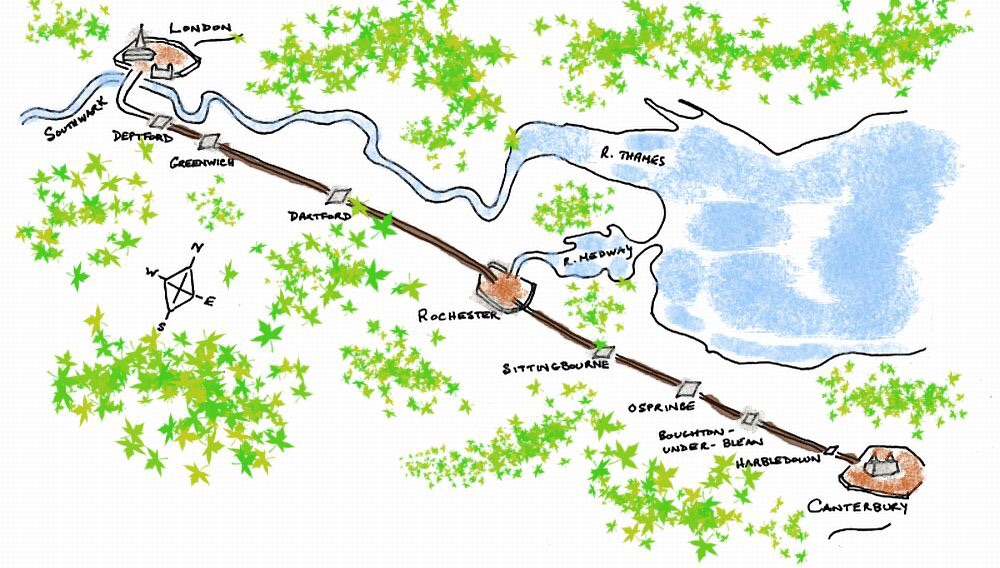
The inn’s host, Harry Bailly, turns into the judge of a storytelling contest he proposes. Each person is supposed to tell two stories on the way to Canterbury and another two on the way back. The prize? Free dinner paid by the rest of the group.
And the stories themselves? It’s a mixed bag. The General Prologue is like the opening scene or exposition of the story where you get a sneak peek at all the characters – and trust me, they’re a mixed bag with some quirky traits.
Some of the characters and their stories are super engaging and funny, while others are kind of dull or just plain bizarre. Of course, we chose the interesting ones for you to read. Chaucer threw in everything – even some stories that make you go, “What was he thinking?” We’ll never know if he would’ve kept those in the final version, because, well, he didn’t get to finish.
So when you’re reading “The Canterbury Tales,” you’re not just reading stories – you’re stepping into a world of unfinished business, a blend of the brilliant and the baffling, all from the mind of a guy who was way ahead of his time.
Okay, let’s time travel back to medieval England and check out the pilgrimage scene. Canterbury was like the hot spot for pilgrims back in the day, but it wasn’t always this way. Before 1170, yeah, there were some cool saint relics around, but it was Thomas Becket’s dramatic martyrdom* that year that turned the city into the medieval equivalent of a tourist magnet.
Thomas Becket was an English archbishop and martyr, famously murdered by knights of Henry II at Canterbury Cathedral. After his death, his tomb and relics became a focus for pilgrimage and he was made a saint.
After they moved Becket’s relics to this fancy new shrine in 1220, that spot became the must-visit place for pilgrims.
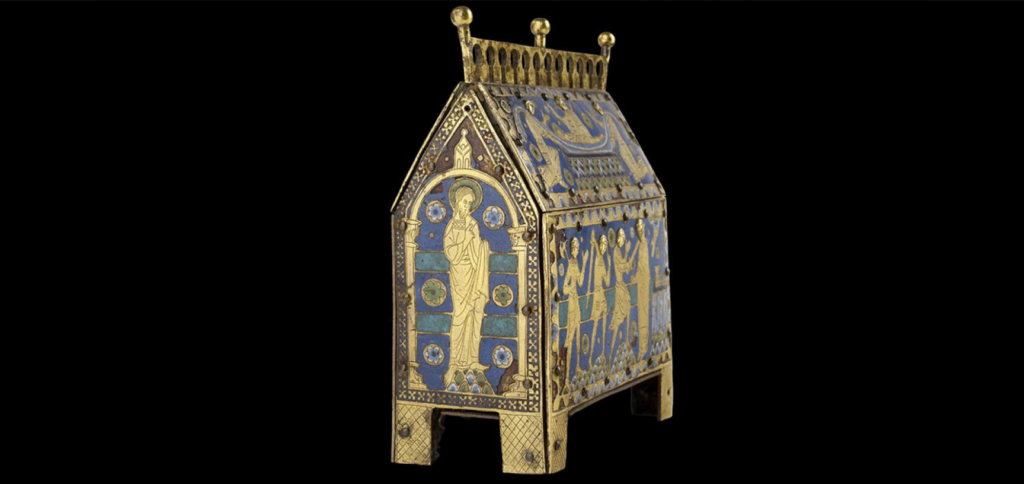
Think of it like going to a fountain that is said to heal your illnesses. The best time to go? Between April and September. The roads weren’t a muddy mess, and the weather was pretty sweet.
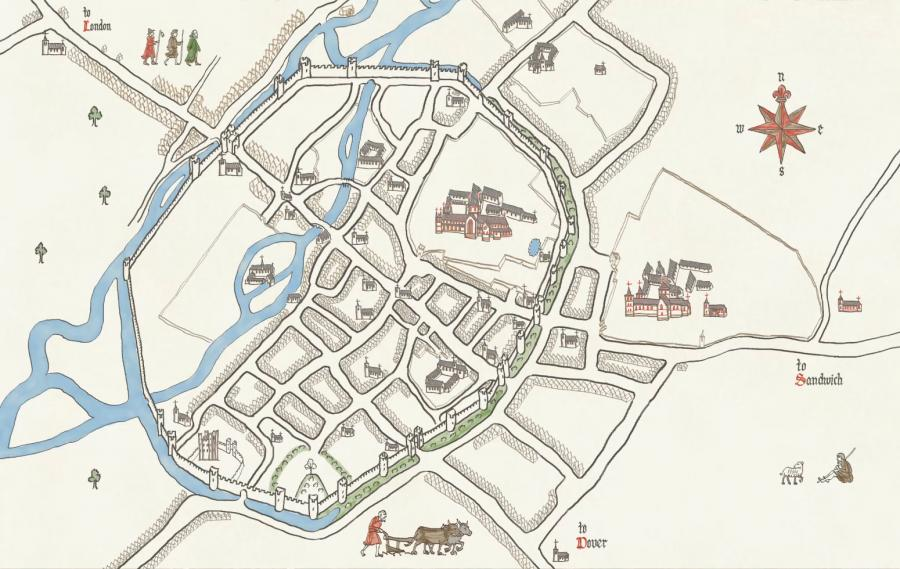
Imagine thousands of people trekking to Canterbury each year. They’re coming from all over, even from different parts of Europe. Some were hardcore and walked the whole way, while the ones with a bit more cash might show up on horseback. And it wasn’t just for the devout. People passing through on business or heading to other parts of Europe would stop by too, probably hoping for some good travel karma from Becket’s shrine.
So picture this: a bustling city, full of people from all walks of life, all there because one guy stood up for what he believed in and became a legend. That’s the power of Thomas Becket’s story and why Canterbury was the medieval place to be.
A playlist inspired by the tales
…in which each song refers to a theme in one of the tales:
Learning Goals
Domein E: Literatuur
Subdomein E1: Literaire ontwikkeling
- De kandidaat kan beargumenteerd verslag uitbrengen van zijn leeservaringen
met ten minste drie literaire werken.
Subdomein E2: Literaire begrippen (alleen vwo) - De kandidaat kan literaire tekstsoorten herkennen en onderscheiden, en
literaire begrippen hanteren in de interpretatie van literaire teksten.
Subdomein E3: Literatuurgeschiedenis (alleen vwo) - De kandidaat kan een overzicht geven van de hoofdlijnen van de
literatuurgeschiedenis en de gelezen literaire werken plaatsen in dit historisch
perspectief.
PTA
HD4
This task is handelingsdeel 4 in your PTA. See Magister:
Kolomkop Hd.4 · Kolomnaam ENTL664 · Kolomomschrijving Channelling Chaucer
Year 5 · Type handelingsdeel, mainly oral · Assessment voldaan / niet voldaan (no resit) · Eindtermen E1, E2, E3 (you work on them here; they are completed in year 6).
This year there is no Vromandag: all scenes are performed in class (see Step 1 and Step 6).
Grammar / Vocab
There are no explicit grammar/vocab or learning goals in this task. The task revolves around literary terminology, analysis, and understanding of the tales.
In year 6, you’ll get exam questions about the tales on your literature exam.